A DAY OF RAGE!
Genenew Assefa June 1, 2011- It is a pity that Rene’ Lefort seem to have thrown his lot with the vocal Diaspora detractors of the Ethiopian government who, for the last 20 years, have been predicting and praying for its immanent downfall. Not least by holding vigils, burning candles, signing petitions, raising funds, all in the hope that one day their dream might come true. Sadder still, for two decades these remnants of Ethiopia’s pre-Federal era have been pleading with foreign powers, particularly the donor community and international banks, to cut aid to Ethiopia and deny the country credit facilities.
By such appeals they reckoned that they could hasten the often told prophecy of Woyane’s inevitable demise. When the folly of this wishful thinking began to sink in, some among them switched tracks. Luckily, just before their frustration level hit rock bottom, they remembered the forgotten zero-sum adage -- the enemy of my enemy is my friend. Thus, by an open admission of their own puniness, the Diaspora politicos pinned their hope on the ONLF and OLF whose agenda is no less bankrupt than their own. The most desperate among them, on the other hand, threw themselves at Issayas’ feet. They implored the dictator to do their bidding in exchange for an undisclosed open-ended deal, leaving it to Issayas to call his reward. But, like others before them, they belatedly discovered that a deal with Issayas is as perilous as a Faustian bargain.
Unsuccessful in all their naïve and treacherous schemes, the bulk of the diehard doomsayers were about to abandon the doomed cause. By some ironic twist of coincidence, however, the Arab Revolt rekindled their hope, albeit against hope, which at least for a fleeting moment, gave their retrograde agenda a new lease on life. Suddenly, mute as it had not been in recent times, a crescendo of talk about replicating Tahrir Square in Ethiopia saturated their websites. Twittering and facebook networking began clinking, calling on Internet users to turn May 28 into a day of rage. Unfortunately for them, the majority of the minority of Ethiopians with access to the high-tech medium has vested interest in peace and tranquility, not to mention the millions waiting their turn to be online.
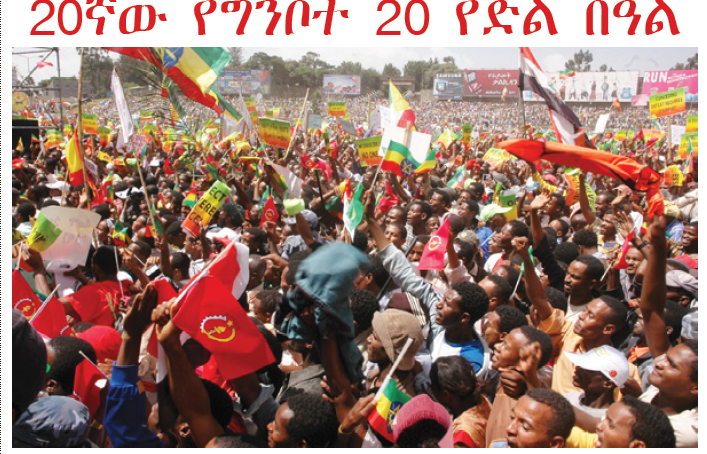
It is at this ill-timed juncture it seems that Lefort saw an opportunity to make a name for himself as a prescient commentator. One who, before any Western analyst, could foretell the precise date and place where the next social-media instigated public revolt would take place in Sub-Sahara Africa. In an article which appeared on May 25 bearing the title: Beka: Will Ethiopia be Next? --- Lefort thoughtlessly pontificates on why the Ethiopian ruling party could be next in line among regimes destined to be washed aside by a North African-like public rage. Believe it or not, Lefort’s forecast almost came true. From the epicenter of Addis Ababa’s Revolution Square, a Day of Rage swept the country on the precise date foretold in his prophetic article. Indeed, on May 28, mammoth rallies were staged in all the major cities of Ethiopia where a million people voiced their outrage just as Lefort told us they would, though by no means can the gathering be construed as the first sure sign that Mubarke’s fate awaits Meles Zenawi. This is the only problem with Lefort’s otherwise accurate forecast. The mass rage that reverberated from end to end was by no stretch of the imagination against an unwanted regime. There was none of the deafening roar ( Al Shab, Yuirid Iscat Al Nizam!) that forced Ben Ali to flee and compelled Mubarek to step down. What instead blasted out of Revolution Square on May 28 was the thunderous voice of over a million people chanting, Beka! Dehenet! And, Hedassew be Mengistachen Ewen Yehonal! The meaning of these Latin transliterations of Amharic mottos which resounded throughout the May 28 rallies may not please Lefort. Because slogans such as --- Enough to poverty! And -- the Ethiopian Renaissance will be achieved by our Government! --- are not exactly manifestations of anti-government public rage much less clarinet calls for regime change: But, expressions of hope in the political order and confidence in government development policies.
Who knows, as Shakespeare has put it, coming events cast their shadows, Lefort may have heard piercing sounds of Beka-- echoing in his ears three days before the may 28 rally. Apparently, that is all he must have heard because at times one hears only what one wants to hear. But the devil, as they say, is in the detail. The question, therefore, is Beka to what? If we have to guess, Lefort must certainly have been taken aback that the public that turned out in record numbers at the May 28 rally did not say --Beka! -- to the EPRDF government. Instead, much to his chagrin and the extremist émigrés’ dismay, something diametrical opposite happened. The 20th anniversary of the fall of the Red Terror Regime turned out to be a solemn occasion of playful reflection. A public forum, if you like, in which citizens from all walks of life renewed their pledge to rally behind the Growth and Transformation Plan. Indeed elated by the fact that the Nile Dam is by any reckoning the jewel of GTP, many more among the demonstrators vowed to help sustain the Hedasse bond purchase spree that has taken the country by storm.
Incidentally, echoing Birhanu Nega, Lefort tells us that the Hedasse Dam is a hoax, concocted by a government frightened by the potential spillover effect of the Arab Revolt. But on what evidence can the Hedasse project be dismissed as a clever hocus aimed at diverting public attention and robbing its meager savings at the same time? Well, according to Lefort, the evidence lies in the timing. As he puts it “This project suddenly appeared from nowhere, as it is not mentioned in the recently adopted five-year plan.” Granted, there is no mention of the Hedasse Dam in the five-Year plan as it was kept secret under a code name, Project X. But surely not even a retarded reader could, after the fact at least, fail to connect the Hedasse Dam with the clearly laid out figures in the GTP that Ethiopian intends to generate 8 to 10 thousand MG in the coming five years. Only God knows from where Lefort and co. think that such a magnitude of electricity would flow into the national power grid. In fact, anyone who followed Meles’ extensive interview with an Arab television network, aired in Egypt, could easily have sensed that Ethiopia was poised to do something big along the Nile. Besides, it does not take a genius to figure out that planning such a huge process takes years. It is a mystery, therefore, how anyone could miss that the site survey, feasibility study, impact assessment and the designing process must necessarily have by many years antedated Bouazizi’s self-immolation and the Tunisian Jasmine revolution. Moreover, as a European, with some connections, Lefort could have made an inquiry into Salini’s projects in Ethiopia. Had he taken this rout instead of relaying on Addis Ababa’s roomer mill, he would have discovered the truth from the horse’s mouth, as it were. For, hearsay aside, the Hedasse Dam project was not hatched out of Meles’ hat to preempt twitters from taking to the streets. Proof that Lefort falls for roomers is his next sweeping statement, “Ethiopian television – state-run and the only official station – hardly mentioned the Arab uprisings.” Again, had he done his homework he would have been spared the embarrassment of being caught out as a sloppy pundit, since the national media has and continues to amply cover the Arab Revolution with numerous commentaries and publications.
This is not all. For Lefort there are other clues that the Ethiopian government is mortified by the specter of a spontaneous uprising similar to that which has been rocking North Africa. Thus, he tells us that Meles is playing the Eritrean card to smother any rebellious mood in the public.
And there was patriotism, on the theme of: ‘let’s overcome our political differences and unite for the defense and development of the mother country’. For the defense: against the arch-enemy, Eritrea. For the first time, Ethiopia publicly declared that its goal was to overthrow the regime of Issayas Afeworki by increasing its support for the Eritrean armed opposition.
Certainly, in a recent press briefing Meles has announced his government’s policy change regarding Eritrea’s terrorist acts against Ethiopia. Knowing the EPRDF, policy is neither framed nor altered on the spur of the moment. If Lefort were to read the history of the EPRDF, he would have learned that no major stand, let alone on a matter as serious as national security, is taken for momentary public consumption. As Lefort knows well, ever since the Algiers Agreement, Ethiopia has been pursuing a policy of containment, prudently avoiding an all-out confrontation, despite Issayas’ numerous covert attacks on civilian targets. Apparently a policy change was necessary, since pure containment has not deterred Issayas’ provocations. The gist of the new policy rests on a simple formula, commensurate retaliation. In other words, the policy is designed to serve Asmara notice that henceforth, every proxy violent measure will be met by an equal and proportional countermeasure. One only hopes that, this time around, Issayas has gotten the message.
No doubt this policy change has coincided with the Arab Revolt. But only a half educated person reads a cause-and-effect relationship into a coincidental convergence of two parallel events. If the new policy were conceived as diversionary ploy, how is it that the national media does not harp on it? Surely, had the Ethiopian government been as desperate as Lefort thinks it is, the media would have unleashed a blistering nationalist campaign, centered on inflaming the now muted indignation against Shabiya. Instead, these days, the big story that is receiving most media coverage is the seemingly unending pro-government mass demonstrations across the entire country, spurred by the Hedasse Dam. Besides, if the government’s intention were shifting public attention away from the Arab Revolt by playing on nationalist sentiments, what better and cost-free opening had come its way than the present opportunity to whip the public into frenzy against Mubrak’s Egypt? To the contrary, the message that is being conveyed to the public is to resist such temptation. Despite Egypt’s obstructionist role vise-a-vise the Hedasse Dam, the public is repeatedly advised not to give in to crass vindictiveness, but to take the moral high ground and extend a hand of friendship to the people of Egypt.
Let us now turn how even in the recent price cap on selected consumer items Lefort sees fear of an Arab Revolt. This is how he puts it. ‘’But most spectacular has been a return to a form of state interventionism completely at odds with the government’s entire economic strategy.’’ There you have it! On Lefort’s considered opinion, the most “spectacular’ proof of official anxiety over the possibility of a repeat of Tahrir Square on Ethiopian soil, is state intervention. One wonders what country Lefort is talking about. For anyone familiar with this government knows that it repeatedly extols the virtues of selective state intervention. And, that even in international forums Meles rarely minces words in debunking neo-liberalism as an ideology that, at least in the 1980s, led Africa to a dead-end in the 1980s. Long before the street turbulence engulfed the Arab world, the EPRDF has been implementing major policies associated with a democratic development state.
Quintessentially what this means is that the state intervenes where the private sector is either incapable or unwilling to invest, or during instances of market failure. The January 6 price cap is only a temporary measure that, though Lefort fails to mention, was warmly received by the overwhelming majority of the consumer and grassroots population. The real objective is breaking the stranglehold of the big importers which had monopolized the market chain of essential goods such as cooking oil. Even at the time of the writing of his article, government intervention had already improved the supply-side and ended the ‘endless queues’ (sic) for oil, sugar etc. Understandably mistakes were made until the administration grasped the intricacies of the retail market. But, much to Lefort’s dismay, no sooner this was strengthened out than his ‘endless queues’ disappeared before, as he would have us believe, somebody incinerated himself out of frustration, and spark a Jasmine revolution. Lefort notwithstanding, this is not the first time that government bypassed the middlemen and intervened to market food items through grassroots Kebele outlets at retail price. Recall, for instance, how as recently as a year ago when the Arab world was not yet up in arms, the government imported massive tones of wheat; oversaw its retailing at affordable price; stabilized the market; and checked inflation. The point here is to underscore the fact that none of the recent interventionist measures have anything to do with preempting some kind of revolution. But, rather they are manifestations of the government’s ideological stance of balancing the dynamics of free market principle by complementary selective state intervention.
The irony is half way into the article, Lefort himself seems have doubts about his own prediction of the possibility of another Jasmine revolution in Ethiopia. After several incoherent rambling about Tigrean economic oligarchy, fear of ethnic carnage, docile Abyssinian psychology etc. which in his opinion converge to mitigate the possibility of and Arab Revolt in Ethiopia, he touches upon at least real militating factor. He says,
…. the average Ethiopian is not running into a wall whenever he tries to move on. The beginning of a middle class has emerged in the wake of the political and economical elite, because the economic realm is still relatively open… a fringe of Ethiopians, among the most educated and the most enterprising, continues to get glimpses of a way out, an opportunity that it can still grasp, by jumping onto the economic elevator. In urban areas, this means joining the circle of businessmen or, if that is not possible, the ever swelling ranks of civil servants. In rural areas, for those who can connect to commercial networks, it means joining the new peasant élite.
Grudgingly put though it may be, Lefort is for once right. Under conditions where youth sees a bright future, and where possibilities abound for an upward social mobility, it is highly improbable that Ethiopia would go the way of Egypt, Tunisia, much less, Libya. A compounding factor that behooves the opposition to bear in mind is that Ethiopia is not, unlike the countries in North Africa, a unitary state. But a federation of self-determining nationalities where local and regional issues, different as they are in each region, carry more weight for citizens. Grievance in one regional state over a specific policy can hardly become a federal case. Hence, by no amount of facebook chat between an 18 Street Diaspora cyber activist in Washington, and a cousin residing around Bole Road in Addis Ababa, could a nationwide rebellion be ignited in Ethiopia.


