|
ETHIOPIA: LANDLOCKED BUT NOT LOCKED OUT April 10, 2016
“If you can’t explain something simply, you don’t really understand
it.” Bill Gates I recently met
a young man outside the hall of a conference venue who asked why I had not yet written
anything about the economic hardships befalling Ethiopia as a result of the
decision to land lock itself following the independence of Eritrea—its former
province. This article
is, therefore, a brief description of what is meant by ‘landlocked’; a listing
of some of the countries that are ‘landlocked’; and a short survey of the
economic consequences of being ‘landlocked’ as confirmed by the available empirical
evidence on the subject. Landlocked
States: A landlocked
state is a sovereign state entirely enclosed by land, or whose only coastline
lie on closed areas. A detailed study of landlocked countries’ human geography
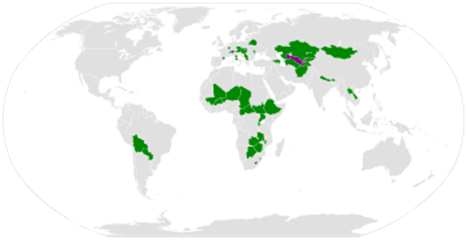
by Caitlin Dempsey (see map), lists a total of 48 countries currently
landlocked, including partially recognized states. 42 of these are landlocked;
two are doubly landlocked; and four are partially recognized states. Only two,
Bolivia and Paraguay are from South America, the rest are all in the
Afro-Eurasia world. As might be
expected, some are affluent states (Switzerland, Luxemburg, and Liechtenstein);
but the majority of these countries are, what economists call, landlocked
developing countries (LLDC’s). Unsurprisingly, Nine out of twelve or 75% are
currently listed as having the lowest HDI (Human Development Index). Of the 48
countries, none are a major power, and 15 are in the continent of Africa. Ethiopia is
the most populous landlocked country on the list with a population of
approximately 100 million people; followed by Uganda, with 40million;
Afghanistan, with 33million; and Uzbekistan, with 32million inhabitants. There
are bigger countries than Ethiopia on the list in terms of landmass, but with
much smaller populations. For instance, Kazakhstan, Mongolia, Chad, Niger, and
Mali all have bigger land mass than Ethiopia. The combined population of all
the LLDC’s is about 475,818,737 or roughly 6.9% of the world’s population (C.
Dempsey). Paul Collier
(2007) surmised “if you are coastal, you serve the world; if you are
landlocked, you serve your neighbors.” So then, what happens to your economic
performance if you are landlocked, your neighbors are poor, small, warring and
unstable? Efforts to
avoid being landlocked include acquiring land that stretches to the sea, and
making arrangements on getting free transport of goods through neighboring
countries. In all cases, however, losing access to the sea has enormous
implications to a country, including, militarily, politically, and most
importantly, with respect to trade and, hence, economic activity and performance. It was
surprising, therefore, when former Prime Minister of Ethiopia, Meles Zenawi declared, that
Ethiopia could do away with ports, and that the absence of ports would not and
could not harm the economy as long as the country was able to garner income
from the resources available to it. To
accentuate his assertion, the former Prime Minister even gave Uganda as an
example of a country that was landlocked but had performed well! His statement was surprising because history is replete with nations “large and small across the world who have striven to gain access to open waters, even at great expense in wealth, bloodshed and political capital”. Also surprising because it is generally agreed that, as a rule, being landlocked creates political and economic handicaps that access to the high seas avoids. So, was the former
Prime Minister’s claims justified based on evidence available at the time and
since? What detrimental repercussions did the policy have on the country’s
external trade performance, if any; and was the policy in concert with the
long-term interests of the Ethiopian state? Was the
Statement Justified Based on Evidence? A quick survey
of the available evidence from the economics literature provides a good basis
for answering the question: was the statement justified based on evidence
available at the time or since? Economists Friberg & Irwin (2009), did a study of landlocked
countries for the period 1950-2000, and concluded that there is a ‘hold up” problem,
meaning problems attributed to landlockedness which
reduce trade by more than 50%; and that free trade agreements can’t overcome
the hurdles posed by landlockedness as they have only
a weak effect on trade. Arvis et al. (2007) conducted a
study of logistics and cost associated with being landlocked, and its impact on
supply chain reliability, and concluded that landlocked countries are affected
by high cost of freight services and a high degree of unpredictability of
transport systems. Mockellar et al. (2000) did a study
of economic development problems of LLDC’s and concluded that the empirical
evidence confirms these countries experience slower economic growth. Gallup et al.
(1999), did a study of geography and economic development, and concluded that
those regions located far from coasts and ocean-navigable rivers have to bear
heavy transport costs of international trade. Furthermore, coastal countries
have higher incomes than land-locked ones. Singh (2010),
conducted a study of international trade and economic growth, and concluded
that the contribution of international trade to growth depends on the volume of
economic activity (i.e., it has to be large enough to make a difference). Rodrik et al. (2004), conducted a
study of the role of institutions vis-à-vis geography, and concluded that the
quality of the institutions of a country is most important and significant for
its income level. Because institutional quality can be controlled, it has more roles
to play in growth than does geography, or even trade, which cannot be
controlled. In a study
conducted by Collier & Gunning (1999), they concluded that Africa had grown
slowly during the 1970s and 1990s, and that was largely due to policies, which
reduced the region’s openness to foreign trade. Furthermore, poor delivery of
public services was the main hurdle of economic growth in the region during the
period. Frankel & Romer (1996), conducted a study of trade and growth, and
concluded that the countries’ geographic characteristics have significant
effect on their trade, and even more effects on income. All of these
studies employed cross-section data, and used econometric techniques of varying
degrees of sophistication. In yet a
highly significant and recent work, R.C. Paudel (2013),
conducted a sophisticated study of landlocked countries’ performance; and concluded
that landlockedness remains to be a significant
problem, and is a specific constraint to export performance and growth. At the
same time, he also observed, that LLDC’s have opportunity to improve their
export performance by: creating a more trade friendly environment through
lowering of tariffs; reforming their exchange rates; and involving themselves
in regional trade arrangements, among others. Paudel’s study further concluded
that the market size of the neighbor has significant impact for a landlocked
country, indicating that a one per cent increase in the market size of a
neighbor of LLDC impacts its growth by an average of about one and half (1½%)
percentage points. As a consequence, a landlocked country surrounded by large
economies has a more advantageous environment for economic growth than those
locked by poor countries. A sobering
implication of the Paudel study includes the finding
that governance quality has statistically significant and positive impact on
economic growth in landlocked developing countries. It suggests that if the
quality of governance improves by an index point, on average, the rate of
economic growth increases by at least two and half (2½%) percentage points,
holding all other variables constant. Ethiopian policy makers should head this observation,
as the country was included in his study sample. In short,
then, and consistent with previous studies, landlockedness
hampers economic growth for LDC’s in general, and LLDC’s in particular. The
magnitude is, of course, different for different countries, depending on the
country. What we also know now is that there is evidence that a good governance
system and policy initiative of trade reform can help reduce the negative
impact of the constraint imposed by landlockedness. What we can say further is that, in all
cases, however, these countries (LLDC’s) are still disadvantaged relative to
countries with similar policies as openness is positively associated with
growth. The moral of the story here is that trade related cost is more crucial
to improving export performance in LLDC’s than just trade liberalization or
reform. To be sure, there are benefits to trade liberalization, but when that
is compared to other countries; the benefits are certainly lower. Was the
Policy in Concert with the Long-term Interest of the Ethiopian State? Being
landlocked remains a specific constraint for the export performance of
Ethiopia. The fact that the country has attempted to gain access to Sudanese
ports in the North; securing the continued use of the Djibouti port to the
East; and now, negotiating the use of the port facilities at Berbera in Somaliland, is an indication of the stresses
Ethiopia is experiencing notwithstanding Meles’ claim.
There have also been attempts as well as future plans in the works to use the
Mombasa port in Kenya to the South. That there are inconveniences, insecurities
as well as delays experienced by business people within the country in terms of
logistics and reliability is undeniable. Furthermore, it is generally assumed
that 30 to 40% of the cost of goods in the heartland can be associated with
transportation costs alone. The
question, thus, remains: how much faster could the country have developed,
holding all other variables constant, had it had its own outlet to the high
seas? While it is generally
acknowledged that Meles was at his best when warring
with Ethiopians, taking on the one state adversary that landlocked his country
was, in the writer’s opinion, against everything that defined him. It was
against his worldview, against his ideology. Granted, that because
distance-related trade costs restrict export performance more in land locked
developing countries than in other developing countries, the decision to
protect a nation’s interests is always a cost/benefit consideration over the
long-term. As such, a leader willing to protect the long term interests of the
nation would have been willing to sacrifice a great deal and inflict what ever cost it would have required to safeguard that
interest. That it did not turn out that way cannot now be considered a “win-win”
given the available evidence regarding this matter. *Teshome Abebe, A Former Provost and Vice President for Academic
Affairs at FSU & EIU, is Professor of Economics, and may be reached at teshome2008@gmail.com |